
The financial industry is undergoing a transformative shift as artificial intelligence continues to redefine how transactions are executed, monitored, and optimized. In a bold step toward the future, Anchorage Digital has introduced AI banking for autonomous payments, signaling a new era of intelligent financial systems. This innovation blends cutting-edge machine learning with secure digital asset infrastructure, enabling systems to make payments independently without constant human intervention.
As global markets demand faster, more efficient, and highly secure financial solutions, the emergence of AI-powered banking is not just a trend—it is a necessity. Businesses and individuals alike are seeking smarter tools to handle transactions, reduce operational friction, and improve decision-making. Anchorage Digital’s initiative positions itself at the intersection of AI-driven finance, blockchain technology, and autonomous payment systems, offering a glimpse into what the next generation of banking could look like.
This article explores how Anchorage Digital launches AI banking for autonomous payments, the technology behind it, its benefits, challenges, and the broader implications for the financial ecosystem.
The Evolution of Digital Banking and AI Integration
From Traditional Banking to Intelligent Systems
Banking has evolved significantly over the past few decades, transitioning from manual processes to digital platforms and now to intelligent automation. Traditional banking relied heavily on human oversight, paperwork, and time-consuming verification processes. The introduction of online banking streamlined operations, but it still required active user participation.
With the rise of artificial intelligence in finance, the landscape has shifted toward automation and predictive capabilities. AI systems can analyze vast amounts of data in real time, detect anomalies, and execute decisions faster than any human operator. Anchorage Digital’s AI banking solution builds upon this evolution by enabling self-executing financial transactions, reducing reliance on manual inputs.
The Role of Machine Learning in Financial Automation
Machine learning algorithms play a central role in enabling autonomous payments. These systems learn from historical transaction data, user behavior, and market trends to make informed decisions. By integrating smart financial automation, Anchorage Digital ensures that payments are not only executed automatically but also optimized for timing, cost, and security.
This shift represents a move toward intelligent banking infrastructure, where systems can anticipate needs, manage liquidity, and handle recurring or conditional payments without direct human intervention.
What Is AI Banking for Autonomous Payments?
Defining Autonomous Payments
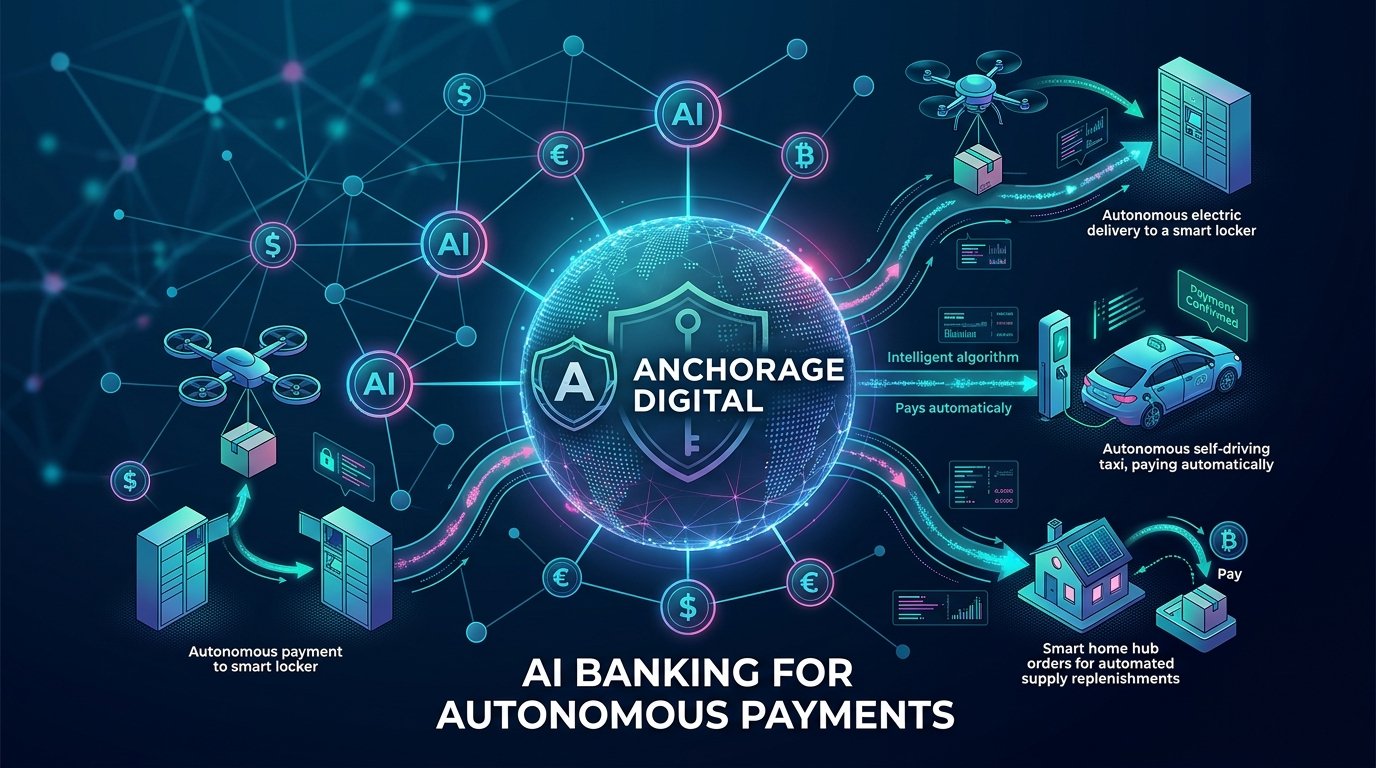
Autonomous payments refer to financial transactions that are initiated, processed, and completed by AI systems without requiring manual approval for each step. These systems operate based on predefined rules, real-time data analysis, and adaptive learning models.
Anchorage Digital launches AI banking for autonomous payments with the goal of creating a seamless financial ecosystem where machines can handle routine and complex transactions efficiently. This includes everything from recurring payments and payroll processing to dynamic treasury management and cross-border transfers.
Key Components of AI Banking Systems
The foundation of AI banking lies in the integration of several advanced technologies. These include blockchain-based security protocols, machine learning algorithms, and real-time data analytics. Together, they create a robust environment where transactions are secure, transparent, and highly efficient.
Anchorage Digital leverages its expertise in digital asset custody to ensure that autonomous payments are not only fast but also compliant with regulatory standards. This combination of secure digital asset management and AI-driven automation sets a new benchmark for modern banking solutions.
How Anchorage Digital Is Leading the Innovation
A Strategic Approach to AI Integration
Anchorage Digital has positioned itself as a pioneer in the digital finance space by embracing AI-driven solutions early. Its approach to launching AI banking for autonomous payments focuses on combining security, scalability, and intelligence.
By integrating AI-powered financial tools with its existing infrastructure, Anchorage Digital enables institutions to automate complex workflows while maintaining full control and transparency. This approach ensures that businesses can adopt autonomous systems without compromising on compliance or risk management.
Enhancing Security Through Intelligent Systems
Security remains a top priority in any financial system, and AI banking is no exception. Anchorage Digital uses advanced algorithms to detect fraudulent activities, monitor transaction patterns, and respond to threats in real time.
The incorporation of predictive analytics in banking allows the system to identify potential risks before they materialize. This proactive approach enhances trust and reliability, making autonomous payments a viable solution for both individuals and enterprises.
Benefits of AI Banking for Autonomous Payments
Increased Efficiency and Speed
One of the most significant advantages of AI banking is the speed at which transactions can be processed. Autonomous systems eliminate delays caused by manual approvals, enabling near-instantaneous payments.
This efficiency is particularly beneficial for businesses that handle high volumes of transactions. By adopting automated financial workflows, companies can reduce operational costs and improve overall productivity.
Improved Accuracy and Reduced Errors
Human errors in financial transactions can lead to costly mistakes. AI systems minimize these risks by executing tasks with precision and consistency. Anchorage Digital’s solution ensures that payments are processed accurately, reducing the likelihood of discrepancies.
The use of intelligent transaction processing further enhances accuracy by continuously learning and adapting to new data inputs.
Enhanced Financial Decision-Making
AI banking systems provide valuable insights through data analysis, enabling better decision-making. Businesses can leverage these insights to optimize cash flow, manage risks, and identify growth opportunities.
With data-driven financial strategies, organizations can make informed decisions that align with their long-term goals.
Challenges and Considerations
Regulatory and Compliance Issues
Despite its advantages, AI banking faces several challenges, particularly in terms of regulation. Financial authorities are still adapting to the rapid pace of technological innovation, and compliance requirements can vary across jurisdictions.
Anchorage Digital must navigate these complexities to ensure that its autonomous payment systems adhere to legal standards. This involves continuous monitoring and updates to align with evolving regulations.
Ethical Concerns and Trust
The idea of machines making financial decisions raises ethical questions about accountability and transparency. Users need assurance that AI systems will act in their best interests.
Building trust requires clear communication, robust safeguards, and ongoing oversight. Anchorage Digital addresses these concerns by implementing transparent AI governance frameworks and maintaining human oversight where necessary.
Technical Limitations
While AI technology has advanced significantly, it is not without limitations. Systems can be affected by data quality issues, algorithmic biases, and unforeseen scenarios.
To mitigate these risks, Anchorage Digital employs continuous testing and refinement of its models, ensuring that its AI-driven banking solutions remain reliable and effective.
The Future of Autonomous Payments
A Shift Toward Fully Automated Financial Ecosystems
The launch of AI banking for autonomous payments marks the beginning of a broader in the financial sector. As technology continues to evolve, we can expect to see more institutions adopting similar solutions.
This shift will lead to the development of fully automated financial ecosystems, where transactions, investments, and risk management are handled by intelligent systems.
Integration with Emerging Technologies
AI banking is likely to integrate with other emerging technologies such as the Internet of Things (IoT) and decentralized finance (DeFi). This convergence will create new opportunities for innovation and efficiency.
For example, IoT devices could trigger payments automatically based on usage data, while DeFi platforms could enable decentralized autonomous transactions. Anchorage Digital’s initiative lays the groundwork for these possibilities.
Conclusion
Anchorage Digital launches AI banking for autonomous payments at a time when the financial industry is ready for a major . By combining artificial intelligence with secure digital infrastructure, the company is redefining how transactions are executed and managed.
This innovation offers numerous benefits, including increased efficiency, improved accuracy, and enhanced decision-making. However, it also presents challenges that must be addressed to ensure widespread adoption.
As AI continues to shape the future of finance, autonomous payments are likely to become a standard feature of modern banking systems. Anchorage Digital’s pioneering efforts highlight the potential of this technology and set the stage for a smarter, more efficient financial ecosystem.
Leave a Reply